TWISS #45: Let's be honest
How our communities and circumstances influence our moral calculus.


Welcome to This Week in Social Science. In this edition, we look at how our community and our life circumstances act as scaffolding for our values. We’ll discuss one classic study of honesty that shows how we mirror the people around us, and one brand new study that explores how we navigate moral tradeoffs when the world gets heavy.
Is honesty a trait or a social contract?
We often discuss honesty as a fixed personal trait, you’re an honest person or you’re not. But one of the pioneering studies in honesty, conducted back in the 1920s, suggests that moral character is situational, acting less like a personality trait and more like a reflection of the people around us.
The researchers studied thousands of schoolchildren, pioneering behavioral measures to observe real-world honesty. For example, researchers had students self-grade a test, unaware that the researchers had made secret carbon copies of the students’ original answers. Discrepancies between the self-graded version and the carbon copy provided strong evidence of dishonesty.
The researchers found shocking inconsistency. Cheating on one task (like a math test) did not predict whether a student would cheat on another (like an athletic competition). Most students cheated a little bit, and very few were always honest or always cheaters. Contrary to contemporary belief at the time, honesty did not seem to be an individual-level trait. In fact, the best predictor of a student’s honesty was the honesty of their peers, suggesting that social norms influenced behaviors more than individual dispositions.
This research suggests that most people are not intrinsically good or bad. We are social mirrors, reflecting the values of our social environment. Though honesty may feel like a private virtue, it might be better described as a collective achievement. A community is honest not because it is filled with “honest people,” but because it has built a culture where people behave honestly.1
Under what conditions will people be dishonest?
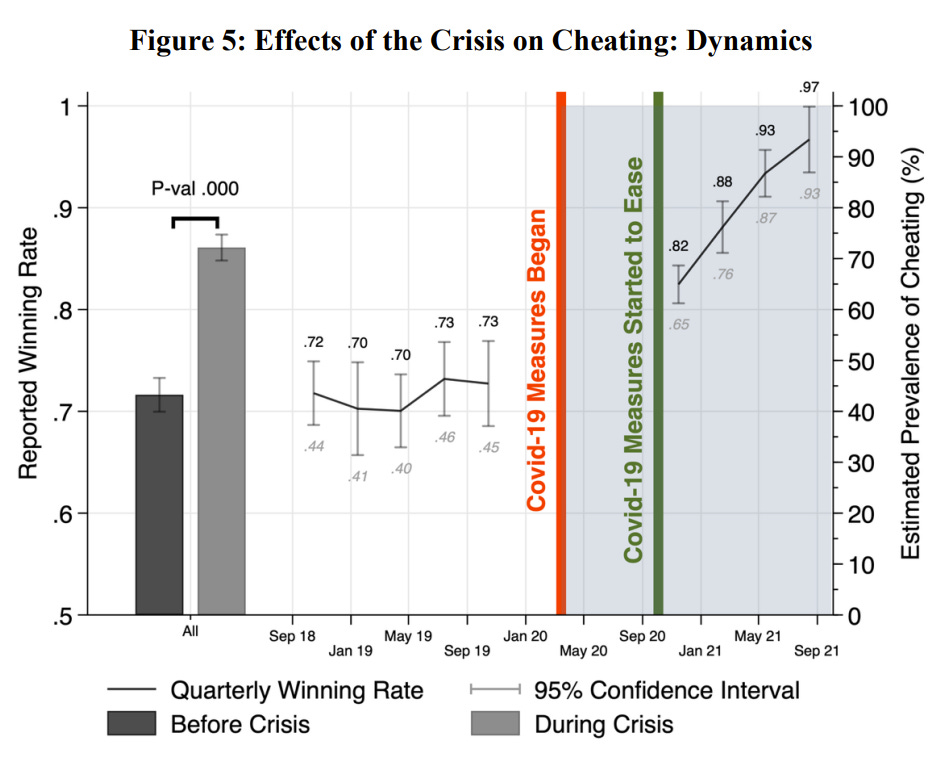
A study in Kenya published earlier this year investigated how economic hardship affects our honesty. To measure honesty, researchers had participants play the Mind Game. In the Mind Game, people flip a coin five times, privately predict each outcome in their mind, and are then paid based on their self-reported accuracy. Though researchers cannot tell who cheats, they can infer how many people cheat by comparing the reported success rate with the 50% benchmark implied by truthful reporting of a coin flip.
The study leveraged a natural experiment in survey timing. Some participants were surveyed before the COVID-19 pandemic and others during it. This randomized survey timing effectively randomized economic hardship: during the pandemic, respondents’ monthly earnings dropped by an average of 51%.
Under normal, pre-pandemic conditions, cheating was rare, with most participants sacrificing substantial amounts of money to avoid cheating. However, economic hardship drove people to dishonesty: the cheating rate rose from around 40% under normal conditions to over 90% deep into the COVID-19 crisis. Researchers suggest that the causes of this dishonesty were twofold: (1) the marginal utility of cheating rose as people’s incomes dropped, and (2) the psychological cost of lying dropped as lying became normalized.
This research demonstrates that honesty does matter to people, but it competes with other values. When hardship hits, people must make moral tradeoffs.2
“Hunger makes a thief of any man.” - Pearl S. Buck (from The Good Earth).
Takeaway
While virtue requires individual willpower, we shouldn’t rely on willpower alone to be virtuous. Instead, we should surround ourselves with people who will hold us accountable and bring out our virtue, while granting ourselves and others grace when circumstances push us to transgress against our own values.
Hartshorne, H., & May, M. A. (1928). Studies in the nature of character: Vol. 1. Studies in deceit. Macmillan.
Livia Alfonsi, Michal Bauer, Julie Chytilová, and Edward Miguel, “Hitting Rock Bottom: Economic Hardship and Cheating,” NBER Working Paper 34695 (2026), https://doi.org/10.3386/w34695.
Very interesting topic once again. It made me think about the one time I cheated on one math problem on one math test in high school and just how uncomfortable I made my friend who mouthed the answer to me. That was a memorable moment in my life, realizing I was surrounded by really good people and unfortunately, at that moment, not feeling like one of them.
It was a long time ago, but that was a valuable lesson in being a good human
Interesting findings. Probably survival instincts in such dire circumstances play a role.