

Welcome to This Week in Social Science. Recently I’ve been wondering: why do (almost) all people all live in states, with governments who collect taxes and provide services to citizens? Why don’t they just keep all of it, only paying the military to keep the rest of us in line? Or why don’t we live in small, homogenous groups with no need for formal governments?
Let’s find out. Today we will look at one classic article explaining the origins of states, and one new article explaining the paucity of states in precolonial Africa.
Governments as Stationary Bandits
In a classic article, the inimitable Mancur Olson described why states would form.
In prehistory, there were communities and there were roving bandits. The roving bandits pillaged the communities, taking all they had and moving on.
But being constantly on the road grew tiring for some bandits. They decided to settle down and monopolize violence in a single location. They still stole for their livelihoods, but they left the community with enough that there would be something to steal next year. These roving bandits became Stationary Bandits.
This transformed the bandits, as the incentives of the Stationary Bandits were now aligned with the community. When roving bandits came to pillage, the stationary bandits protected the community – not out of benevolence, but to protect their own incomes.
These Stationary Bandits even began using their wealth to provide public goods to the community, like roads and criminal justice. Growing wealth for the community meant growing wealth for the Stationary Bandits.
You see where this is going. The Stationary Bandits began to govern, and became what we now call The Government.1
“In a world of roving banditry there is little or no incentive for anyone to produce or accumulate anything that may be stolen and, thus, little for bandits to steal.” — Mancur Olson
Africa and Political Decentralization
If the logic of governance is inevitable, why were centralized states so rare in precolonial Africa?
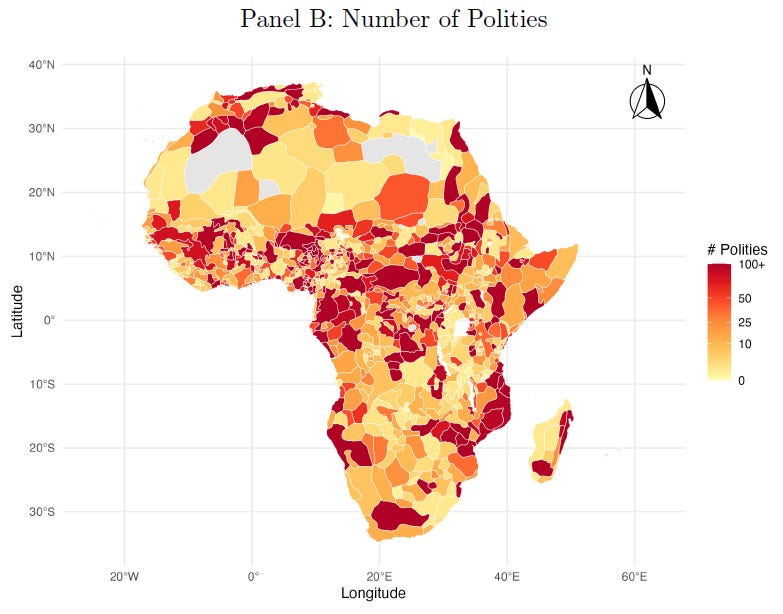
A new paper suggests pre-colonial African societies were deliberately organized to prevent centralized states from emerging. Before the colonial era, the authors estimate that Africa had ~45,000 distinct polities, no more than 2% of them centralized states as we use the term today.
Why? The researchers synthesize an enormous amount of ethnographic research suggesting that African communities refused centralization in order to safeguard egalitarianism and their own autonomy.
These societies developed norms and institutions to prevent the accumulation of power by individuals or small groups. For example, many societies distributed political authority among elders, which prevented ambitious individuals from accumulating political power. Other societies developed beliefs about witchcraft that prevented accumulation of power. Someone accumulating too much wealth or influence was suspected of being a witch.
This deliberate decentralization came with unintended consequences: most African polities did not develop integrated economies or the military technologies of large state-ified polities, and could not defend their autonomy when those large states showed up.
This research suggests that African societies were successful at maximizing a different set of values than Western societies, not “failed” versions of Western societies as they have often been portrayed.2
Takeaway
States may have formed due to the logic of exploitation: the more you have, the more I can take. This logic aligns the incentives of the thieves with the thieved; governments that provided more for their people were able to extract more, creating a virtuous cycle of extraction and provision.
These governments were even able to amass military power and coerce other communities into joining their growing states. It is possible that many members of early states did not join voluntarily, but that is a story for another TWISS.
Still, state formation was not inevitable, and communities in different parts of the world made different calculations about the competing tradeoffs of statehood. This week we looked at research about Africa, but people in many parts of the world formed different understandings about the relationship between the government and the governed.
Like most insightful research, these studies inspire even more questions than they answer. We’d love to know your thoughts.
Music Credit: “War Time Poem” by Tigran Hamasyan.
Olson, M. (1993). Dictatorship, democracy, and development. American political science review, 87(3), 567-576.
Soeren J. Henn and James A. Robinson, “Africa as a Success Story: Political Organization in Pre-Colonial Africa,” NBER Working Paper 34546 (2025), https://doi.org/10.3386/w34546.
Does this suggest that centralization comes from within? I had always thought that power-hungry societies would force their neighbors to centralize in order to resist conquest, with cascading effects.
I wonder if there's a tipping point of how many societies can centralize power before the balance of social power shifts.
If that makes sense. 😊
I’m not sure I really buy into this “roving bandit” vs “stationary bandit” theory. I’m by no means an expert, but I have never read of the vast majority of leaders being unrelated to the general population of the group. As far as I know, the chiefs usually were part of the tribe and family.
What is the evidence for stationary banditry, as opposed to naturally occurring hierarchy as families grow and groups merge into larger groups? The paper you linked did not seem to provide any evidence.