

Welcome to This Week in Social Science. It is easy to be cynical these days, to believe that we the people don’t matter, that politicians serve only the rich and our preferences are irrelevant to political decisions. And for years, research supported that position. However, a new paper out this year argues that this conclusion was incorrect, the result of a faulty methodological decision.
Today we will look at the original research, the recent refutation, and my thoughts.1
Only the Affluent Have Influence?
In his seminal 2005 book Affluence and Influence, Martin Gilens asked: who really governs in America? Whose preferences are reflected in public policies: the average citizen, or only the rich?
To answer that question, he aggregated historical public opinion data for nearly 2,000 public policies, separating the preferences of the rich (90th percentile), poor (10th percentile), and middle-class (50th percentile). Since the groups’ policy preferences heavily overlap, he looked specifically at areas where group preferences diverge.
He found that government policy was “fairly responsive to the well-off and virtually unrelated to the desires of the low- and middle-income citizens.”
This research suggested that the government only responds to the political preferences of the rich. Poor and middle-class Americans still generally get what they want, but only because upper-class Americans tend to agree with them.2
“government policy appears to be fairly responsive to the well-off and virtually unrelated to the desires of the low- and middle-income citizens.”
The Public’s Real Influence
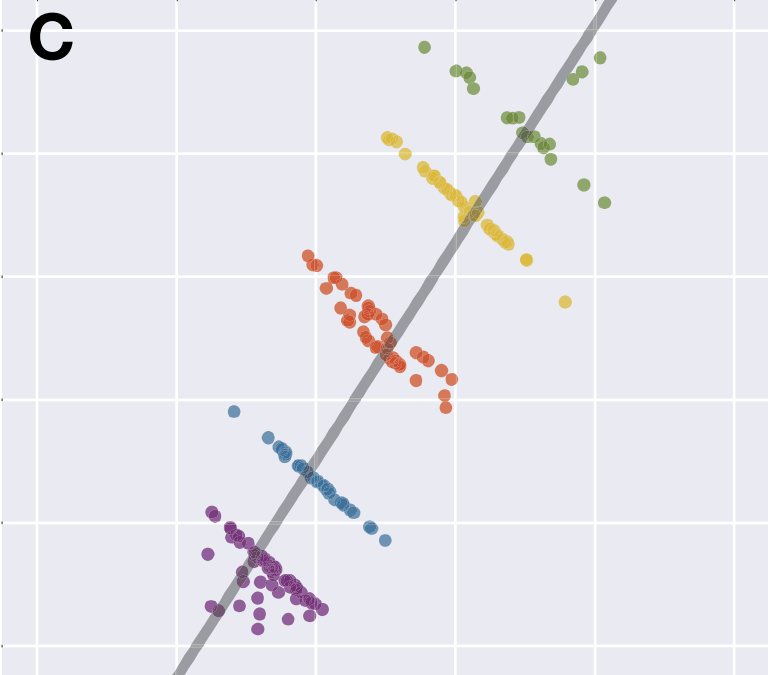
A new article by Peter Enns demonstrates that the findings of Affluence and Influence were based on faulty methodology. Only analyzing data when income groups express different levels of policy support introduced Simpson’s Paradox, a statistical phenomenon where a trend appears in a subset of the data but does not exist in the data as a whole.
Enns shows that policy is equally responsive to the rich and poor – as each group’s support for a policy rises, the likelihood of that policy being adopted rises at the same rate.
The original analysis found the opposite because it only analyzed the subset of policies where rich and poor voters disagreed. While this seems intuitive, it caused Simpson’s Paradox for two reasons:
First, policies with relatively more support among the rich have a higher baseline adoption rate than policies with relatively more support among the poor, even when very few of the rich support the policy.
For example, a policy supported by 17% of the rich and 6% of the poor is more likely to pass than its inverse, a policy favored by 17% of the poor and only 6% of the rich.
Second, looking only at policies where high and low income voters disagree means looking at the subset of policies supported by low-income voters that also have low baseline adoption rates.
In statistical terms, the regression intercept of the rich is higher, but not the regression slope. Only looking at the subset of data with disagreement confused the poor’s lower intercept for a lower slope.
This research shows that policy is equally responsive to different income groups, and how seemingly intuitive methodological choices can lead to misleading conclusions.3
Takeaway
I am compelled by Enns’ new research. It looks like government policy is responsive to public opinion. Equal responsiveness to rich and poor is what democratic theory would predict: each vote is equally valuable, whether the voter makes $20,000/year or $200,000/year.
But we must still ask deep questions about democratic accountability. For example:
What issues even get on our political agenda?
How can the truly wealthy — not 90th percentile, but 99.9th percentile — influence public opinion?
These are likely the real ways money influences politics. Not by policy responding more to rich voters than poor, but the ultra-wealthy wielding influence over the political agenda and public opinion.
End note: I join Peter Enns in lauding Martin Gilens and his coauthors for their work, even as I believe their analysis led to misleading conclusions about political influence. They brought attention to questions of political influence, conducted monumental data collection, and made the data publicly available so that the results could be replicated and challenged. This is how science progresses.
This week’s articles came to us from Jay Gulledge. Thank you, Jay! If you ever see research we should cover, email us at twiss.weekly@gmail.com.
Music Credit: “War Time Poem” by Tigran Hamasyan.
Gilens, M. (2012). Affluence and influence: Economic inequality and political power in America. Princeton University Press.
Enns, P. K. (2026). How a Seemingly Innocuous and Intuitive Methodological Choice Confused a Generation of Research on Policy Responsiveness. Sociological Science, 13, 528-564.
Great post! I have no trouble understanding Simpson’s Paradox in theory, but when it gets applied to a real world case it suddenly takes me an embarrassingly long amount of time to wrap my brain around it. But your explanation helped my poor brain along.
I listened to a Strength in Numbers podcast with Enns about this study. He was careful to say that his analysis does NOT indicate that there is no bias in favor of the wealthy. Rather, he concluded that it is inaccurate to say that policy is only responsive to the rich or that policy does not respond to middle- or low-income voters’ preferences. In contrast, Gilen’s work has often been characterized as showing that middle- and low-income voters’ preferences simply do not matter. Like Chris, I found Enns’s argument persuasive and I think it opens up new research directions for understanding how broad participation can influence policy. Perhaps those working for policy reform are missing opportunities that don’t rely primarily on moving elites.